
Week 5— The Art of Simplicity: Seamless Bathrooms for China’s New Generation
- Genco Berk
- Aug 7
- 5 min read
The bathroom is one of the smallest rooms in the house, but also one of the most personal. It is where we begin and end our day—half-awake in the morning and slowly disconnecting from the outside world at night.
For generations, bathrooms were designed around one priority: functionality. They needed to be easy to clean, resistant to moisture, and durable enough to last for decades.
Today, our expectations have changed. The bathroom is no longer just a practical space. It has become a private retreat—a place for calm, comfort, and a moment of escape.
The Bathroom of the Past
Your parents’ bathroom was likely a study in practicality: walls covered in small white tiles, their grout lines darkening over time, creating a visible grid that made the space feel increasingly busy. The tiles were everywhere because they were reliable, protecting the walls from moisture and making cleaning easier.
The vanity was usually a sturdy, practical piece with visible doors, handles, and exposed plumbing. The sink often sat on top like a separate object rather than an integrated element. A medicine cabinet projected from the wall, filled with everyday necessities. Towels hung wherever space allowed, while bottles of shampoo, soap, and cleaning products slowly turned the bathroom into a storage area rather than a place of relaxation.
It wasn’t bad—it was practical. It reflected the priorities of its time. A bathroom was designed to work, not to impress.
But for many of us, these spaces also felt visually overwhelming. Small tiles, dark grout lines, exposed hardware, mismatched bottles, and visible wear created a constant sense of activity. The eye had nowhere to rest.

The Seamless Approach
A seamless bathroom takes a different approach: Instead of adding more elements, it removes unnecessary visual interruptions.
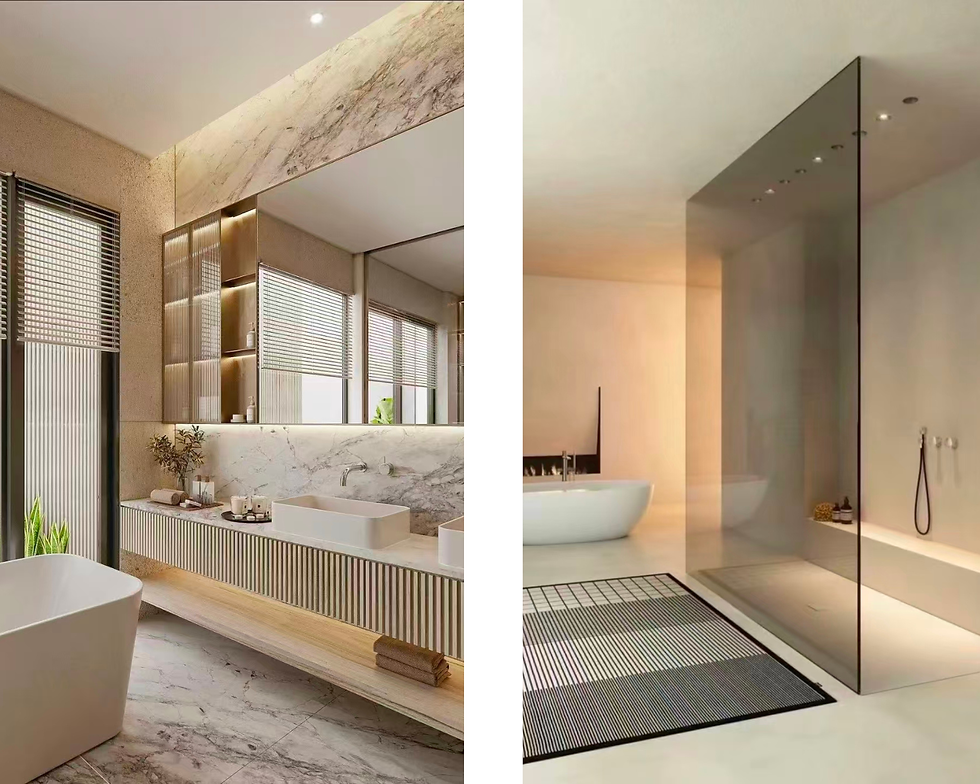
Vanities float above the floor, creating a lighter appearance and making cleaning easier.
Cabinet doors open with a gentle push, eliminating visible handles.
Medicine cabinets disappear into the wall behind full-height mirrors.
Shower enclosures become almost invisible, using frameless glass with minimal hardware.
Storage is carefully planned so everyday items disappear when not in use.
The result is not luxury for the sake of luxury. It is about creating a space where the eye can relax—and where the mind can follow.
Three Budgets, One Idea
A seamless bathroom is not defined by how much money is spent. The principle remains the same at every level:Reduce visual noise. Create order. Let the space breathe.
Entry-Level (Low Budget)
You don’t need a complete renovation to make your bathroom feel calmer. The biggest improvement often comes from removing unnecessary visual distractions.
Paint the walls in a soft, neutral color—warm white, pale gray, or light sage green.
Replace traditional vanity handles with push-latches if possible.
Remove unnecessary countertop items and organize daily products in simple trays or baskets.
Use matching containers for shampoo, soap, and cleaning products instead of displaying many different packages.
Replace colorful shower curtains with a simple plain fabric or neutral tone.
Add better lighting to reduce shadows and make the room feel cleaner.
The goal is not to create a luxury bathroom. It is to create a bathroom that feels intentional. Estimated cost: ¥500–2,000

Middle Income
With a moderate investment, the bathroom can begin to feel like a private spa.
Install a floating vanity with a flat-panel design and minimal detailing.
Replace a traditional medicine cabinet with a full-height mirror hiding a recessed storage cabinet.
Upgrade to a frameless shower enclosure to create a more open feeling.
Use moisture-resistant materials for cabinetry and walls.
Add a recessed shower niche to keep bottles organized and hidden.
Choose larger-format tiles to reduce the number of grout lines.
The most important investments are not decorative. They are the elements that improve the overall visual calm of the space. Estimated budget: ¥20,000–50,000


Luxury
At the highest level, every element becomes part of one continuous composition.
Use large-format porcelain slabs or continuous surfaces with minimal joints.
Install a fully floating vanity with integrated drawers and no visible supports.
Create a hidden mirror cabinet with integrated lighting, electrical outlets, and soft-close mechanisms.
Design a curbless shower with a linear drain and minimal glass framing.
Install a floating toilet with the tank concealed inside the wall.
Use integrated lighting instead of relying only on visible ceiling fixtures.
Consider natural materials such as stone, wood veneer, or textured surfaces to add warmth.
The goal is not simply to make the bathroom expensive. It is to create a space where every decision feels considered. Estimated budget: ¥150,000–500,000+




A Note on Ventilation
Moisture is the enemy of seamless design.A beautiful floating vanity, hidden cabinet, or painted wall will not last if humidity is ignored. Good ventilation is not a technical afterthought—it is part of the design concept.
Entry-level: Use a reliable exhaust fan and keep airflow moving after showers.
Middle income: Install a quieter, more powerful fan with a timer switch.
Luxury: Use a high-capacity silent ventilation system with humidity sensors and smart controls.
A seamless bathroom is not only about appearance. It is about creating a space that remains beautiful over time.
Final Thought
Your parents’ bathroom was designed around necessity: tiles for protection, cabinets for storage, mirrors for practicality. Today, we are looking for something different. Not more decoration. Not more objects. More calm.
A seamless bathroom creates a sense of order in a world that is increasingly noisy. It gives us a place to slow down before the day begins and disconnect when the day ends.
And achieving that feeling does not always require a complete renovation. Sometimes the biggest transformation comes from small decisions: removing clutter, simplifying surfaces, hiding unnecessary elements, and allowing the space itself to become the focus.
The bathroom may be the smallest room in the house—but when designed thoughtfully, it can become one of the most peaceful.
Next week: A seamless home is only as good as the materials behind it. We’ll explore the engineered boards that make flush doors, floating cabinetry, and flawless wall panels possible—from affordable domestic options to Austrian Egger and Italian Cleaf.


Comments